

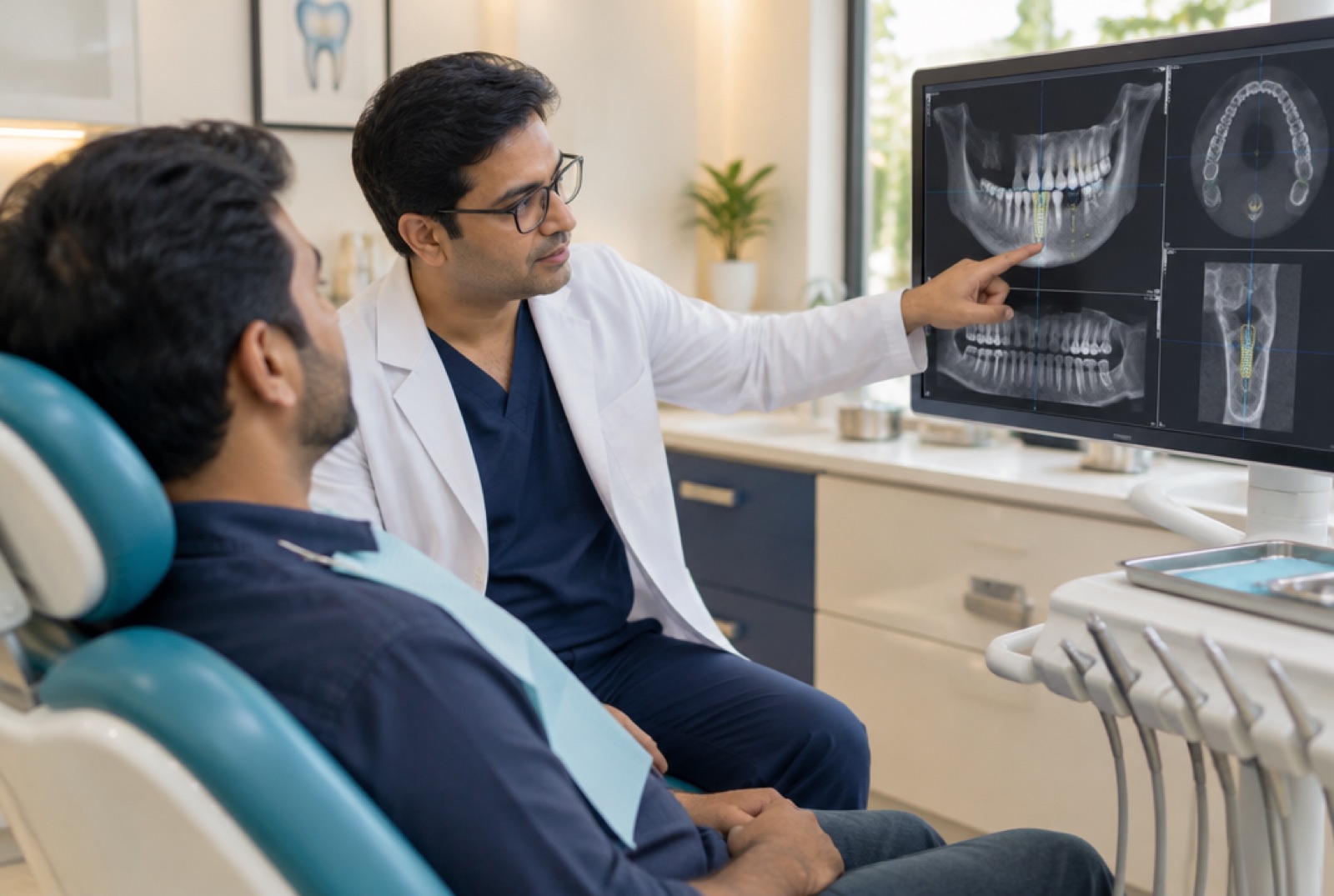
A dental implant replaces the root of a missing tooth and carries a crown, bridge or denture. The implant must bond with the jawbone before the final teeth are fitted. That usually takes months, so most international patients plan two trips to India. Your dentist sets the timeline after seeing your scan.
At a glance
- Who should perform it
- BDS dentist or MDS specialist, registered with a State Dental Council
- Trips to India
- Usually two trips, months apart
- Before you fly home
- As your dentist advises
- Recovery
- Implants bond with bone for 2–6 months (Leeds NHS)
What does the procedure involve?
The implant is placed into the jawbone. After healing an abutment and the final crown or bridge are fitted. Some patients need a bone graft first, which adds time.
Who is it usually for?
- Adults with one or more missing teeth
- People with enough healthy jawbone, or who are willing to have a graft
- People whose gum disease and diabetes are under control
Suitability is decided by your dentist after an assessment. This list is general.
How do I choose a qualified dentist in India?
- Dentists in India hold a BDS degree and specialists an MDS. Since 19 March 2026 dentistry is regulated by the National Dental Commission, which replaced the Dental Council of India. Dentists register with their State Dental Council.
- Ask for the dentist’s name, qualification and State Dental Council registration number before you book.
- NABH runs a separate accreditation programme for dental clinics and hospitals covering sterilisation, infection control and patient safety. We give preference to accredited clinics.
- Ask which implant system or crown material will be used and for written details of it. Your dentist at home will need them later.
How should I plan the trip?
First visit: assessment, CBCT scan and implant placement. Second visit: the final teeth. A Leeds NHS leaflet says implants are left for 2 to 6 months to bond with the bone, and the restorative stage may take several visits a few weeks apart.
What does recovery look like?
The American Dental Association describes three phases: placement, healing while bone grows around the implant, then fitting the teeth. Some patients receive both in one visit when the dentist judges it suitable.
Your treating dentist gives you a written plan for your own recovery and follow-up.
Questions to ask before you book
- What is the full treatment plan, stage by stage, and how many visits does it need?
- Which implant system or materials will you use, and can I have that in writing?
- What can be done on this trip and what must wait for the next one?
- What happens if something needs adjusting after I go home?
What to prepare for your case review
- A recent OPG X-ray or CBCT scan
- Notes from your own dentist
- Medical history, especially diabetes, smoking and blood thinners
What does it cost?
We do not publish prices. Cost depends on your case, the dentist, the materials and the length of stay, so a single number would mislead you. Through the free case review you receive written estimates from the clinics and hospitals themselves.
Medical decisions
IndiaMedica is not a hospital or clinic and does not give medical advice. We do not show before-and-after photographs because results vary from person to person. Your treating dentist decides on your treatment.
Sources
- American Dental Association — Dental implants
- Leeds Teaching Hospitals NHS — Dental implants
- National Dental Commission replaces the Dental Council of India, 19 March 2026 (ThePrint)
- NABH — Dental Healthcare Service Providers accreditation
- NHS Fife — Dental treatment abroad
Checked
Questions patients ask
Can I have implants in one trip?
Sometimes, when the dentist judges immediate loading suitable. Many patients need two visits several months apart.
What should I take home?
The implant system, model and size of each implant, in writing, plus your X-rays. Your dentist at home will need them.