

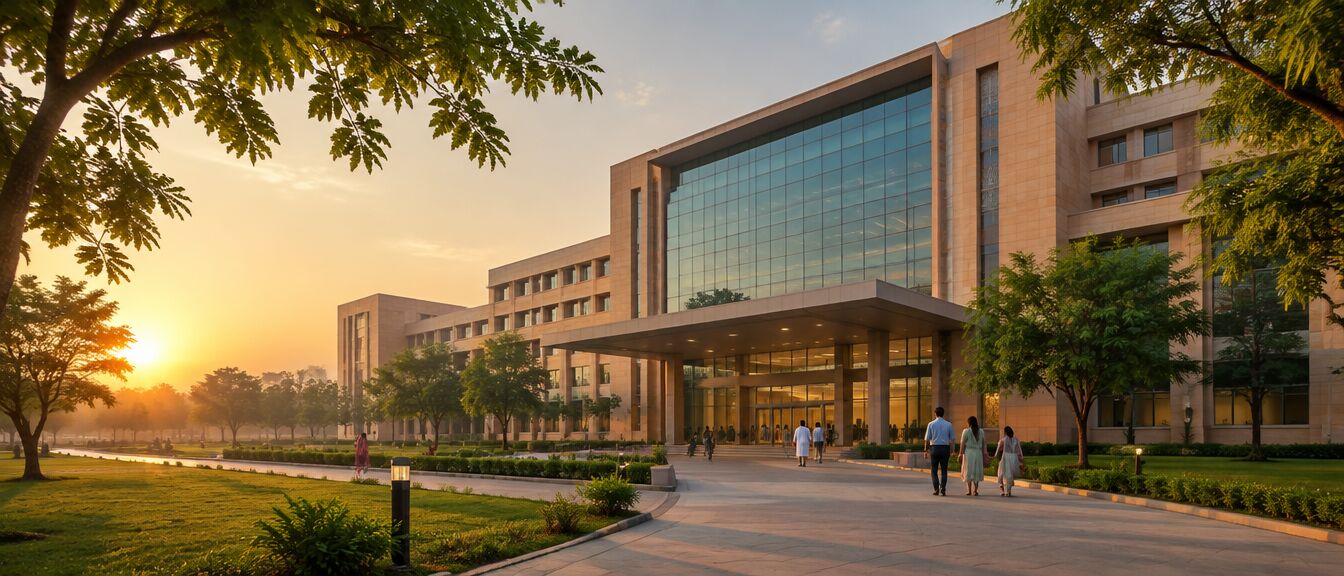
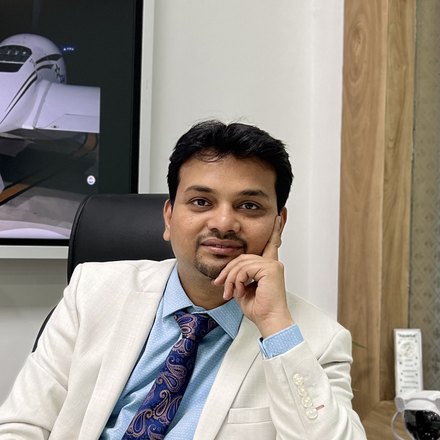
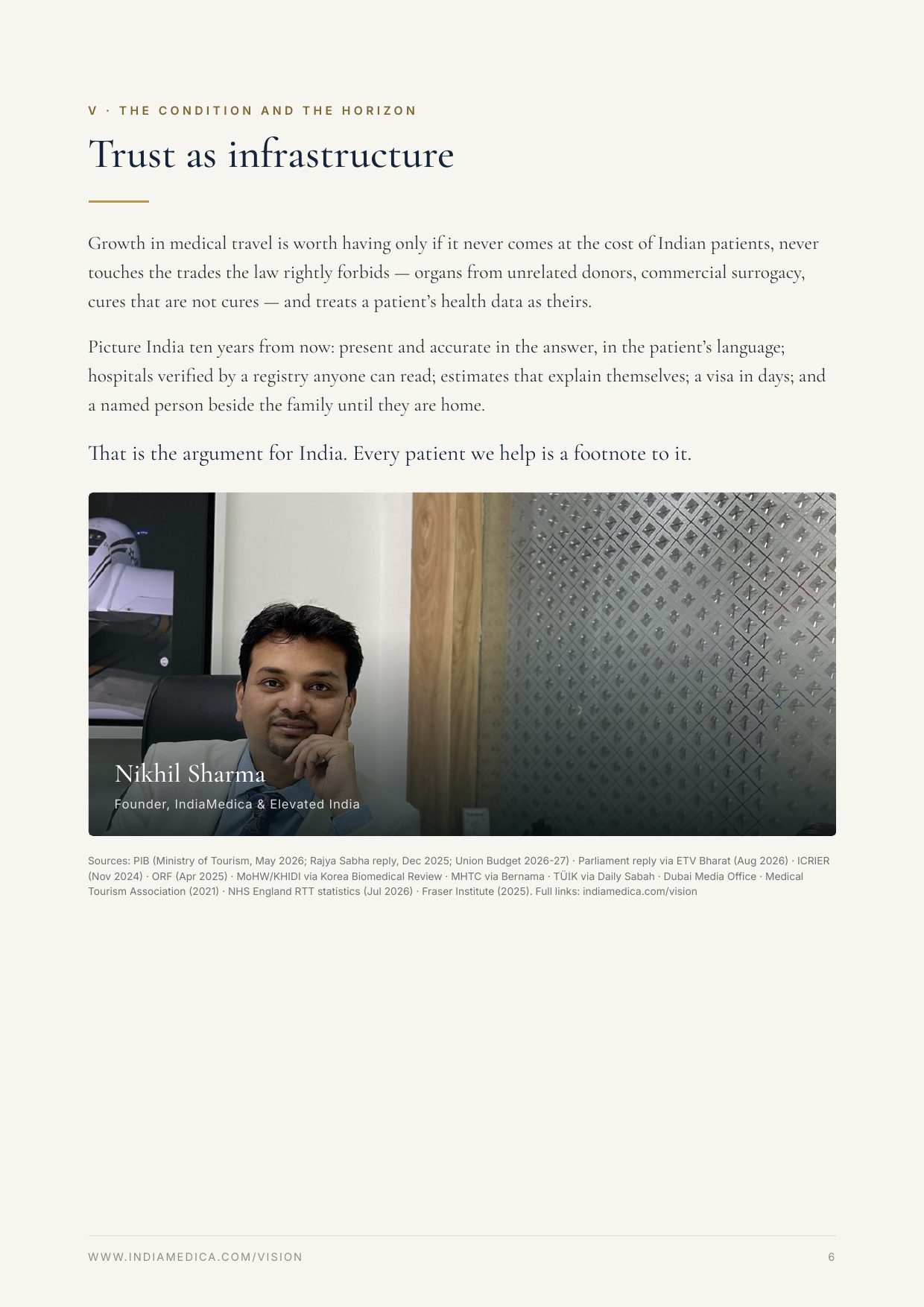
I founded Elevated India on the conviction that India is under-presented, not under-endowed. IndiaMedica is the same conviction applied to the journeys that matter most — the ones people make not for pleasure but for their lives.
What follows is not a brochure. It is one founder’s argument, with the evidence laid out so that anyone can check it: that India deserves a far larger place in the world’s healthcare, that it is losing ground it should be gaining, and that the remedy is known.
The paradox, in numbers
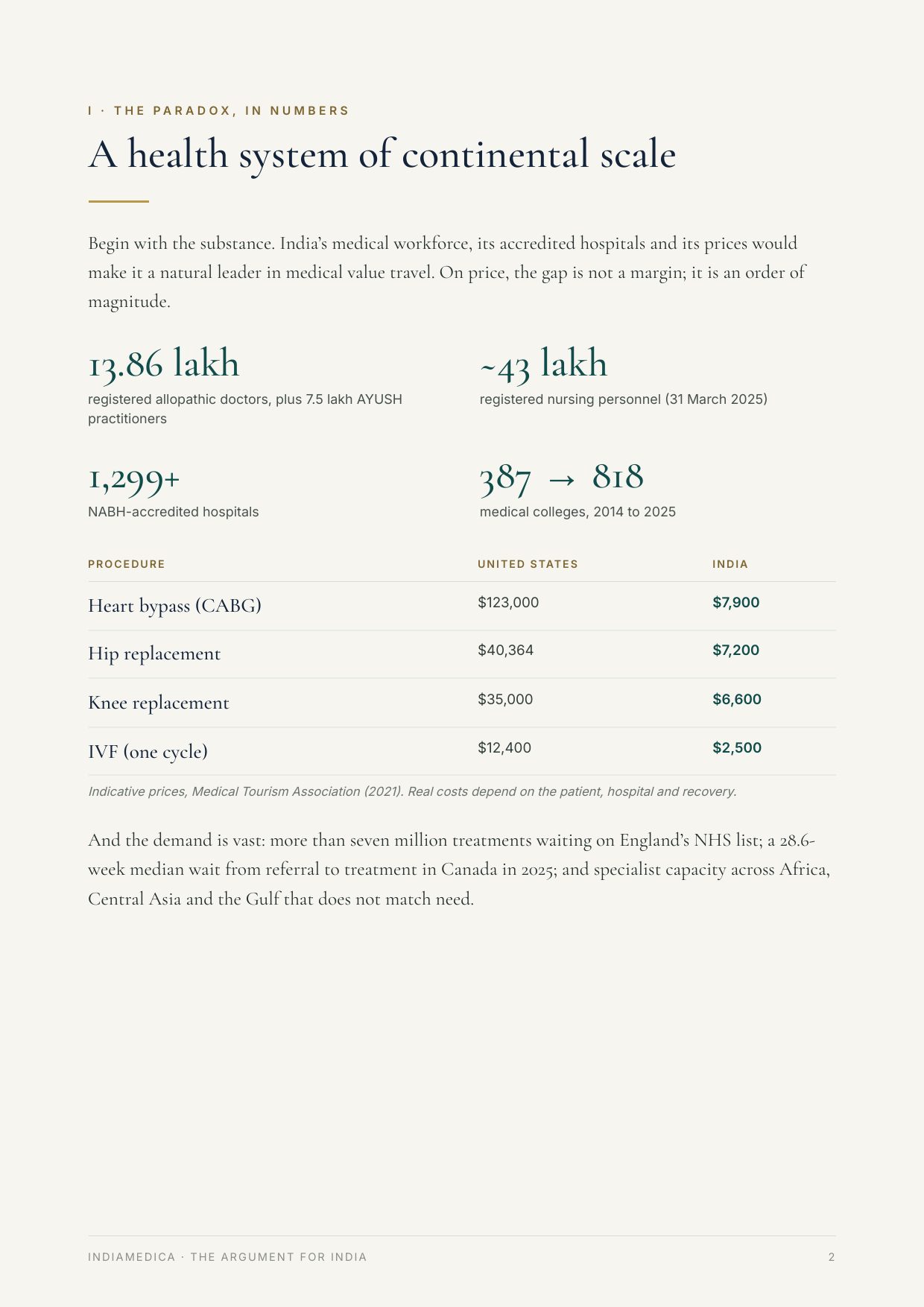
Begin with the substance. India has 13.86 lakh registered allopathic doctors, 7.5 lakh AYUSH practitioners and nearly 43 lakh registered nursing personnel. Between 2014 and 2025 the number of medical colleges more than doubled, from 387 to 818. More than 1,299 hospitals hold NABH accreditation. And on price, the gap is not a margin; it is an order of magnitude.
| Procedure | United States | India |
|---|---|---|
| Heart bypass (CABG) | $123,000 | $7,900 |
| Hip replacement | $40,364 | $7,200 |
| Knee replacement | $35,000 | $6,600 |
| IVF (one cycle) | $12,400 | $2,500 |
Indicative prices published by the Medical Tourism Association (2021). Real costs depend on the patient, the hospital and the recovery.
Now the demand. In England more than seven million treatments are waiting on the NHS list. In Canada the median wait from a family doctor’s referral to treatment reached 28.6 weeks in 2025. Across Africa, Central Asia and much of the Gulf, specialist capacity simply does not match need. The world spends well over a hundred billion dollars a year travelling for care, and the Government of India cites estimates that this will more than double by 2030.
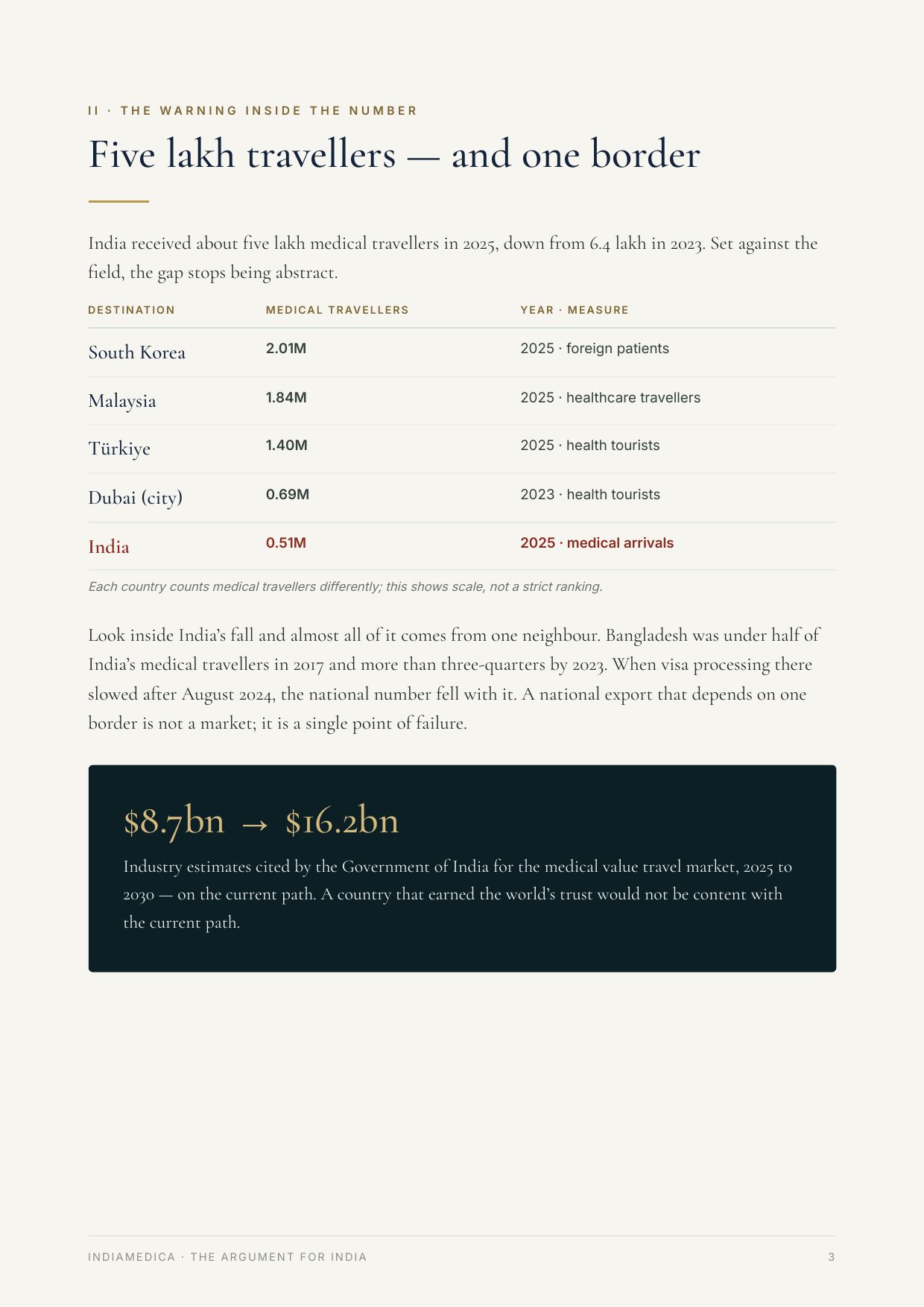
And yet India received only about five lakh medical travellers in 2025 — some 5.5 percent of its foreign arrivals — down from 6.4 lakh in 2023. Set that against the field, and the gap stops being abstract.
| Destination | Medical travellers | Year · measure | |
|---|---|---|---|
| South Korea | 2.01M | 2025 · foreign patients | Dermatology is 62.9% of it — a country that built a category |
| Malaysia | 1.84M | 2025 · healthcare travellers | RM 3.34bn in revenue, under one national agency |
| Türkiye | 1.40M | 2025 · health tourists | USD 3.02bn in revenue |
| Dubai (city) | 0.69M | 2023 · health tourists | One city, more than India’s entire medical inbound |
| India | 0.51M | 2025 · medical arrivals | Down from 6.4 lakh in 2023 — and ~64% from one country |
Each country counts medical travellers differently, so this shows scale rather than a strict ranking. Sources at the foot of the page.
South Korea, a country with a fraction of India’s doctors, treated around two million foreign patients in 2025. Malaysia treated 1.84 million. Türkiye earned over three billion dollars. A single city, Dubai, received more health tourists in 2023 than the whole of India did in 2025. This is not the arithmetic of a country with little to offer. It is the arithmetic of a country whose offering is not yet trusted at the scale it deserves.
“India does not have a talent problem or a price problem. It has a trust problem — and trust is a discipline, not a destiny.”
The warning inside the number
The fall from 2023 to 2025 is not a verdict on Indian medicine. Look inside it and almost all of it comes from one border. Bangladesh was under half of India’s medical travellers in 2017 and more than three-quarters by 2023. When visa processing there slowed sharply after August 2024, the national number fell with it. In 2025 Bangladesh still accounted for roughly two of every three medical arrivals.
A national export that depends on one neighbour is not a market; it is a single point of failure. The next six source markets on the government’s own list — Iraq, Uzbekistan, Somalia, Turkmenistan, Oman and Kenya — together sent fewer than a hundred thousand patients. That is the size of the opportunity, and the size of the neglect.
The Government of India cites industry estimates that India’s medical value travel market grows from about USD 8.7 billion in 2025 to USD 16.2 billion by 2030. That is the trajectory on the current path. A country that diversified its markets and earned the world’s trust would not be content with the current path.
The trust gap, diagnosed
The gap is not a mood. It is made of five specific frictions, and naming them is the first act of fixing them.
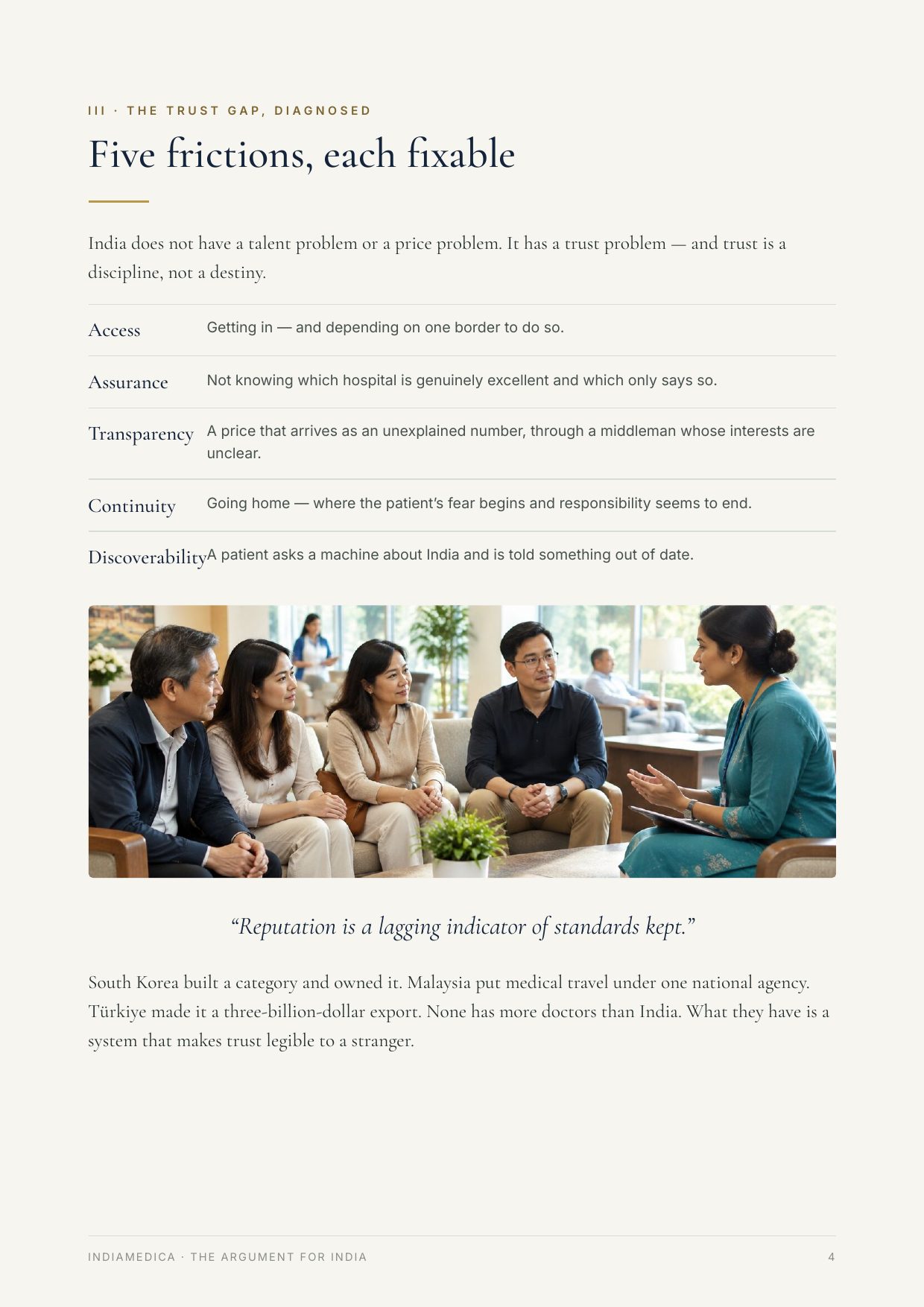
Access — the friction of getting in, and of depending on one border to do so. Assurance — the friction of not knowing which hospital is genuinely excellent and which only says so. Transparency — the friction of a price that arrives as an unexplained number, through a middleman whose interests are unclear. Continuity — the friction of going home, where the patient’s fear begins and the hospital’s responsibility seems to end. And Discoverability — the friction of the answer, where a patient asks a machine about India and is told something out of date.
None of these is a flaw in Indian medicine. Each is a flaw in the machinery around it. Machinery can be rebuilt. That is the whole optimism of this essay.

What the world’s leaders teach
India need not invent this playbook. South Korea built a category — dermatology makes up nearly two-thirds of its foreign patients — and owned it. Malaysia put medical travel under a single national agency and grew to 1.84 million healthcare travellers. Türkiye turned health tourism into a three-billion-dollar export. Dubai made one city a destination for care.
The pattern is the same everywhere: reputation followed deliberate standards, easy access and a story told clearly — in that order. None of these countries has more doctors than India. Several have fewer. What they have is a system that makes trust legible to a stranger.
“Reputation is a lagging indicator of standards kept. A health system that is not well described will not be well chosen.”
The thesis: trust as infrastructure
Here is the idea I have staked a company on. When a house holds itself to a standard — every badge proven, every price explained, every commission disclosed, one person beside the family from the first report to the flight home — it proves that India can be chosen with confidence. Hold that standard privately, over enough patients and enough years, and it stops being one house’s promise and becomes the market’s expectation.
A private house cannot legislate a nation’s health exports, and should not try. But it can build a benchmark visible enough that the market moves toward it, and that policymakers can point to. My ambition for IndiaMedica is not merely to guide patients well. It is to help move the benchmark for how the world chooses care in India.

Six moves that would close the gap
I offer these not as demands but as one founder’s argument. They are meant to be argued with and improved upon. The government has already begun — the Union Budget for 2026-27 provides for five Regional Medical Hubs with facilitation centres — and these moves would compound that start.
Open more than one door
India’s medical inbound has become a single-border business: Bangladesh was under half of medical travellers in 2017 and over three-quarters by 2023, so when visa processing there slowed in 2024, the whole national number fell with it. The cure is not one market less but many markets more — the Gulf, Central Asia, East and West Africa, the diaspora and the long-wait health systems of the West — each with e-Medical visa access that is fast, predictable and well explained in their own language.
Make accreditation legible
India has more than 1,299 NABH-accredited hospitals and a few dozen with international accreditation. A patient in Basra or Bishkek cannot tell them apart from a hospital that merely says so. A single public registry — searchable, current and in the languages of source markets — would turn the country’s real quality into something a family can verify before they buy a ticket.
Publish honest prices
The single most powerful fact about Indian healthcare is its cost, and it is the fact patients trust least, because it reaches them as an unexplained number. Standardised package estimates — what is included, what is not, what changes the bill — would do more for India’s reputation than any advertisement.
Make care continuous
Treatment does not end at discharge; that is where a patient’s fear begins. Structured teleconsultation follow-up, records the patient can carry and their own doctor can read, and a named contact for the months after surgery would answer the question every family silently asks: who looks after us when we are home?
Raise the standard of the middle
Between patient and hospital stands the facilitator — sometimes a guide and sometimes only a toll-collector. A simple code for facilitators — disclosed commissions, no donor or surrogacy brokering, data protection under the DPDP Act, and a register of those who comply — would protect patients and the country’s name at once.
Be present in the age of the answer
The patient of this decade asks a question and is handed an answer, increasingly by a machine. Much of what it finds about India is out of date — the old 60-day visa rule is still everywhere. Accurate, sourced, multilingual information is not marketing; it is the front door of a national health export, and it should be built like infrastructure.
The ethical condition
Growth in medical travel is only worth having on three conditions. First, it must never come at the cost of Indian patients: capacity built for the world should add to care at home, not draw it away. Second, it must never touch the trades the law rightly forbids — organs from unrelated donors, commercial surrogacy, cures that are not cures. India’s transplant rules and surrogacy law exist for good reasons, and any facilitator who works around them harms the country’s name for everyone. Third, a patient’s health data is theirs; it moves only with consent.
These are not constraints on the ambition. They are the reason it can last.
A decade out
Picture India ten years from now. A family in Nairobi, Tashkent or Leeds asks where to go, and India is present, accurate and clearly explained in the answer — in their language. The hospital they choose is verified by a registry anyone can read. The estimate they receive explains itself. The visa takes days, not weeks. A named person meets them at the airport and stays with them until they are home — and answers the phone in the months after.
That India is not a fantasy. It is the sum of a great many standards kept — by government, by hospitals, by the doctors and nurses who already deliver world-class care every day, and, I hope, by us.
That is the argument for India. Every patient we will help is a footnote to it.

Read it here
The argument in six pages. Turn it with the arrows, the buttons, or by clicking either side of the spine.

Prefer it on paper? Download the PDF.
- 1.PIB, Ministry of Tourism — medical arrivals 2025, source markets, NABH count, market estimates (May 2026)
- 2.Medical-visa arrivals 2023–2025, Parliament reply as reported by ETV Bharat (Aug 2026)
- 3.ICRIER policy brief — Bangladesh share of India’s medical tourists 2017–2023 (Nov 2024)
- 4.ORF — Medical tourism and India–Bangladesh relations (Apr 2025)
- 5.South Korea foreign patients 2025 — MoHW/KHIDI via Korea Biomedical Review
- 6.Malaysia healthcare travellers 2025 — MHTC via Bernama
- 7.Türkiye health tourism 2025 — TÜİK via Daily Sabah
- 8.Dubai health tourists 2023 — Dubai Media Office / DHA
- 9.Procedure prices, US vs India — Medical Tourism Association (2021, indicative)
- 10.Doctors, AYUSH practitioners, nurses, medical colleges — PIB, Rajya Sabha reply (Dec 2025)
- 11.NHS England referral-to-treatment statistics (July 2026)
- 12.Fraser Institute — Waiting Your Turn 2025 (Canada)
- 13.Indian e-Visa portal — e-Medical visa terms
- 14.Union Budget 2026-27 — Regional Medical Hubs (PIB)
- 15.Medical Tourism Index 2020–21