

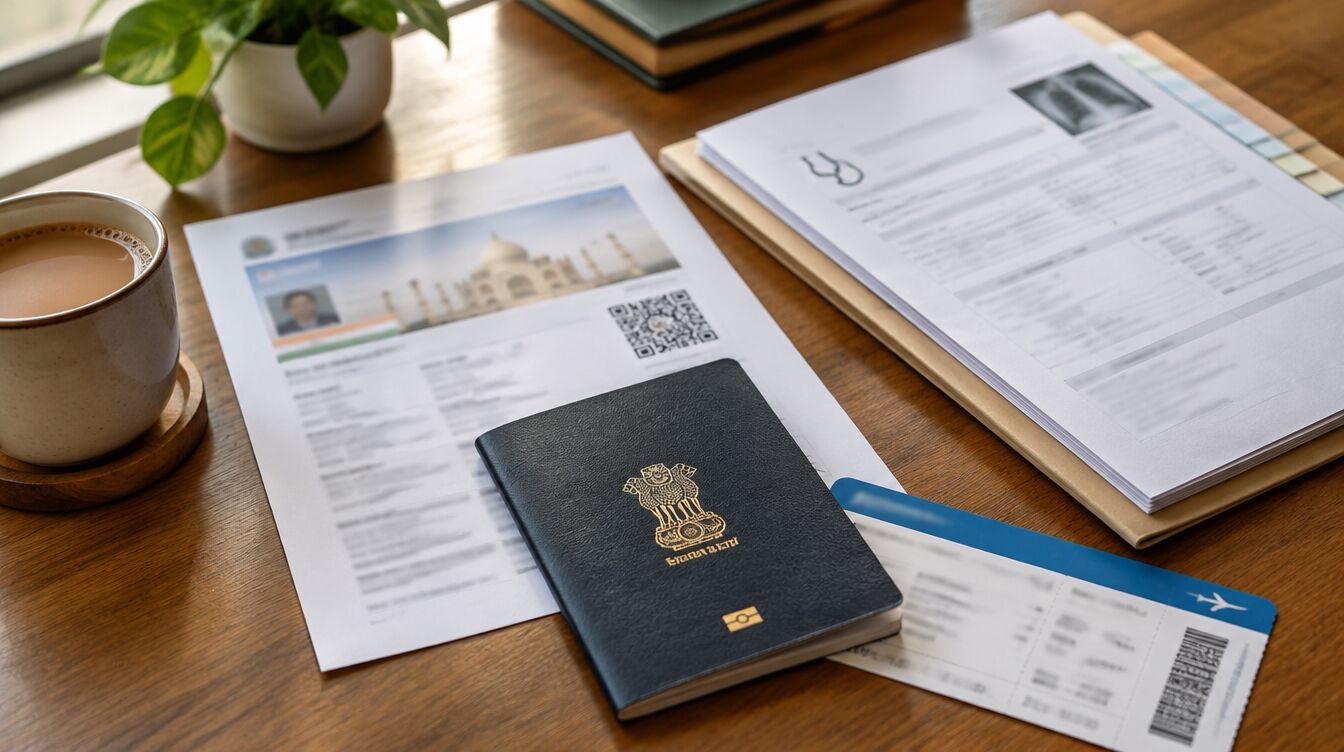
Checklist
A foreign national can have a living-donor transplant in India only with a near-relative donor whose relationship is certified by their embassy on Form 21, and only after the hospital’s authorisation committee approves the case. Start collecting identity, relationship and medical papers early. Originals must be shown at the committee interview. IndiaMedica never sources donors.
India regulates organ transplants under the Transplantation of Human Organs and Tissues Act and its rules. NOTTO publishes the official forms. Form 21 is the certificate of relationship between donor and recipient for foreigners, issued by the embassy concerned. Form 18 is the certificate from the hospital’s authorisation committee. Each state and hospital adds its own detail. The lines below follow the official checklist published by the State Organ and Tissue Transplant Organisation in Goa, which is a useful model. Ask the transplant hospital for its own list before you start, and follow it exactly.
Which relationship documents are needed?
- Form 21: relationship certificate issued by your country’s embassy in India, or by your government if there is no embassy.
- Passports of donor and recipient, with attested copies.
- Birth, marriage and family documents that prove the relationship, such as birth certificates of children.
- A family photograph showing donor and recipient together, if the hospital asks for it.
- Proof of any name change, such as a marriage certificate or official gazette notice.
- Police verification of address and records for donor and recipient, with signed photographs, if required.
Which statutory forms will the hospital prepare?
- Form 1 for a near-related living donor, or Form 2 for a spouse donor.
- Form 4: certificate of the donor’s medical fitness from a registered medical practitioner.
- Form 5: certificate of genetic relationship, supported by tests from an NABL-accredited laboratory.
- Form 11: application for approval of transplantation from a living donor.
- The hospital’s registration certificate for transplantation (Form 16 or 17).
- Form 18: the authorisation committee’s decision, issued after the interview.
Which affidavits may be required?
- Recipient’s affidavit with a complete family tree.
- Donor’s affidavit with a family tree and the reasons for donating.
- Recipient’s affidavit listing near relatives and why others cannot donate, with proof.
- Next-of-kin affidavits from both families approving the donation.
- Ask the hospital whether affidavits must be signed in India and how they must be notarised.
Which medical reports should you bring?
- The recipient’s diagnosis and treatment certificate from the treating physician.
- Blood group reports for donor and recipient.
- HLA typing reports, and DNA profiling where the hospital requires it.
- Recent investigations, scans and specialist letters for both donor and recipient.
- Psychological assessment reports, if the hospital asks for them.
What should you check before travel?
- Confirm the hospital holds a valid transplant registration.
- Confirm the exact Form 21 wording your embassy uses and how long it takes.
- Ask which visa the donor should travel on and get the hospital’s visa letter for each person.
- Carry all originals and three sets of copies, kept in separate bags.
- Plan for all relevant family members to attend the committee interview if required.
Tip: print this page or save it as a PDF from your browser’s print menu.
What the law does not allow
The Goa checklist states that Indian living donors wanting to donate to a foreigner other than a near relative will not be considered. Any offer to find or pay a donor is illegal. IndiaMedica never sources donors and works only with near-relative cases that the hospital committee assesses.
Questions people ask
What is Form 21?
Form 21 is the certificate of relationship between donor and recipient in cases involving foreigners. It is issued by the embassy of the country concerned. The authorisation committee uses it with other documents to assess the relationship. Ask your embassy how to apply.
Who approves a transplant for a foreign patient?
The hospital’s authorisation committee reviews the documents, interviews the donor and recipient and issues its decision on Form 18. If the hospital has no committee, a district or state committee does this. The treating team decides medical suitability.
Can the transplant hospital help with the paperwork?
Yes. Transplant coordinators guide families through the forms and affidavits. Ask for their checklist in writing before you travel. IndiaMedica can help you organise documents and questions, but the hospital and committee make every decision.
Sources
- NOTTO: THOTA forms including Form 21
- SOTTO Goa (Government of Goa): Living donor transplant checklist
General information, not medical or legal advice. Rules change: confirm with the official source. How we write and check.